


Portal:History


The History Portal
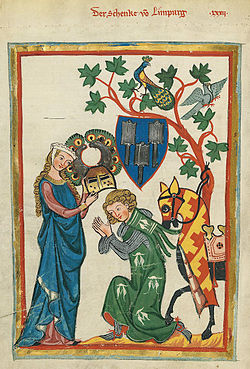
History is the systematic study of the past, focusing primarily on the human past. As an academic discipline, it analyses and interprets evidence to construct narratives about what happened and explain why it happened. Some theorists categorize history as a social science, while others see it as part of the humanities or consider it a hybrid discipline. Similar debates surround the purpose of history—for example, whether its main aim is theoretical, to uncover the truth, or practical, to learn lessons from the past. In a more general sense, the term history refers not to an academic field but to the past itself, times in the past, or to individual texts about the past.
Historical research relies on primary and secondary sources to reconstruct past events and validate interpretations. Source criticism is used to evaluate these sources, assessing their authenticity, content, and reliability. Historians strive to integrate the perspectives of several sources to develop a coherent narrative. Different schools of thought, such as positivism, the Annales school, Marxism, and postmodernism, have distinct methodological approaches.
History is a broad discipline encompassing many branches. Some focus on specific time periods, such as ancient history, while others concentrate on particular geographic regions, such as the history of Africa. Thematic categorizations include political history, military history, social history, and economic history. Branches associated with specific research methods and sources include quantitative history, comparative history, and oral history.
History emerged as a field of inquiry in antiquity to replace myth-infused narratives, with influential early traditions originating in Greece, China, and later in the Islamic world. Historical writing evolved throughout the ages and became increasingly professional, particularly during the 19th century, when a rigorous methodology and various academic institutions were established. History is related to many fields, including historiography, philosophy, education, and politics. (Full article...)
 Featured articles –

-

Chesapeake was a 38-gun wooden-hulled, three-masted heavy frigate of the United States Navy. She was one of the original six frigates whose construction was authorized by the Naval Act of 1794. Joshua Humphreys designed these frigates to be the young navy's capital ships. Chesapeake was originally designed as a 44-gun frigate, but construction delays, material shortages and budget problems caused builder Josiah Fox to alter his design to 38 guns. Launched at the Gosport Navy Yard on 2 December 1799, Chesapeake began her career during the Quasi-War with France and later saw service in the First Barbary War.
On 22 June 1807 she was fired upon by HMS Leopard of the Royal Navy for refusing to allow a search for deserters. The event, now known as the Chesapeake–Leopard affair, angered the American public and government and was a precipitating factor that led to the War of 1812. As a result of the affair, Chesapeake's commanding officer, James Barron, was court-martialed and the United States instituted the Embargo Act of 1807 against the United Kingdom. (Full article...) -
Roderic Stanley (Stan) Dallas, DSO, DSC & Bar (30 July 1891 – 1 June 1918) was an Australian fighter ace of World War I. His score of aerial victories is generally regarded as the second highest by an Australian, after Robert Little, but there is considerable dispute over Dallas's exact total. Though his official score is commonly given as 39, claim-by-claim analyses list as few as 32, and other research credits him with over 50, compared to Little's official tally of 47. Like Little, Dallas flew with British units, rather than the Australian Flying Corps. Beyond his personal combat record, Dallas achieved success as a squadron leader, both in the air and on the ground. He was also an influential tactician and test pilot. His service spanned almost the entirety of World War I fighter aviation.
Born on a remote property in rural Queensland, Dallas showed an early interest in aviation. He travelled to England at his own expense following the outbreak of World War I and became a pilot in the Royal Naval Air Service (RNAS) in August 1915. Initially seeing action with No. 1 Naval Wing on the Western Front in Caudrons and Nieuport 11s, he was chosen to test one of the earliest Sopwith Triplanes. This became his favourite type, and he achieved many victories with it through 1916–17, earning the Distinguished Service Order, and the Distinguished Service Cross and Bar. He was appointed commanding officer of No. 1 Squadron RNAS in June 1917. On the establishment of the Royal Air Force on 1 April 1918, he took command of No. 40 Squadron. Flying Royal Aircraft Factory S.E.5s, he achieved further victories before being killed in action on 1 June 1918 while on patrol near Liévin in northern France. He was buried in Pernes. (Full article...) -
Windsor Castle is a royal residence at Windsor in the English county of Berkshire, about 25 miles (40 km) west of central London. It is strongly associated with the English and succeeding British royal family, and embodies almost a millennium of architectural history.
The original castle was built in the 11th century, after the Norman invasion of England by William the Conqueror. Since the time of Henry I (who reigned 1100–1135), it has been used by the monarch and is the longest-occupied palace in Europe. The castle's lavish early 19th-century state apartments were described by the art historian Hugh Roberts as "a superb and unrivalled sequence of rooms widely regarded as the finest and most complete expression of later Georgian taste". Inside the castle walls is the 15th-century St George's Chapel, considered by the historian John Martin Robinson to be "one of the supreme achievements of English Perpendicular Gothic" design. (Full article...) -
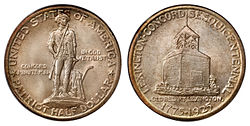
The Lexington–Concord Sesquicentennial half dollar, sometimes the Lexington–Concord half dollar or Patriot half dollar, is a commemorative fifty-cent piece struck by the United States Bureau of the Mint in 1925 in honor of the 150th anniversary of the Battles of Lexington and Concord, which began the American Revolutionary War. It was designed by Chester Beach and features Daniel Chester French's 1874 The Minute Man statue on the obverse.
Members of the Massachusetts congressional delegation introduced legislation in 1924 which would provide for a commemorative half dollar for the anniversary. The bill passed both houses of Congress and was signed by President Calvin Coolidge. Beach had to satisfy committees from both Lexington and Concord, and the Commission of Fine Arts passed the design only reluctantly, feeling Beach had been given poor materials to work with. (Full article...) -

Operation Uranus (19–23 November 1942) was a Soviet strategic operation on the Eastern Front of World War II which led to the encirclement of Axis forces in the vicinity of Stalingrad: the German Sixth Army, the Third and Fourth Romanian armies, and portions of the German Fourth Panzer Army. The Red Army carried out the operation at roughly the midpoint of the five-month long Battle of Stalingrad, aiming to destroy German forces in and around Stalingrad. Planning for Operation Uranus had commenced in September 1942, and developed simultaneously with plans to envelop and destroy German Army Group Center (Operation Mars) and German forces in the Caucasus.
Due to the length of the front lines created by the German 1942 summer offensive, which had aimed at taking the Caucasus oil fields and the city of Stalingrad, German and other Axis forces were over-extended. The German decision to transfer several mechanized divisions from the Soviet Union to Western Europe exacerbated their situation. Furthermore, Axis units in the area were depleted by months of fighting, especially those which had taken part in the struggle for Stalingrad. The Germans could only count on the XXXXVIII Panzer Corps, which had the strength of a single panzer division, and the 29th Panzergrenadier Division as reserves to bolster their Romanian allies guarding the German Sixth Army's flanks. These Romanian armies lacked the heavy equipment to deal with Soviet armor. In contrast, the Red Army deployed over one million personnel for the offensive. Soviet troop movements were not without problems: concealing their build-up proved difficult, and Soviet units commonly arrived late due to logistical issues. Operation Uranus was first postponed by the Soviet high command (Stavka) from 8 to 17 November, then to 19 November. (Full article...) -
SS Montanan was a cargo ship built in 1912 for the American-Hawaiian Steamship Company. During World War I service for the United States Army Transport Service, she was known as USAT Montanan. Montanan was built by the Maryland Steel Company as one of eight sister ships for the American-Hawaiian Steamship Company, and was employed in inter-coastal service via the Isthmus of Tehuantepec and the Panama Canal after it opened.
In World War I, USAT Montanan carried cargo and animals to France, and was in the first American convoy to sail to France after the United States entered the war in April 1917. USAT Montanan was torpedoed and sunk by U-90 500 nautical miles (900 km) west of Le Verdon-sur-Mer, France, while it took part in another eastbound convoy in August 1918, Of the 86 men aboard the ship, 81 were rescued by a convoy escort; five men died in the attack. (Full article...) -
HMS Agincourt was a dreadnought battleship built in the United Kingdom in the early 1910s. Originally part of Brazil's role in a South American naval arms race, she holds the distinction of mounting more heavy guns (fourteen) and more turrets (seven) than any other dreadnought battleship, in keeping with the Brazilians' requirement for an especially impressive design.
Brazil ordered the ship in 1911 as Rio de Janeiro from the British company Armstrong Whitworth. However, the collapse of Brazil's rubber boom and a warming in relations with Argentina, the country's chief rival, led to the ship's sale while under construction to the Ottoman Empire. The Ottomans renamed her Sultan Osman I, after the empire's founder, and the ship was nearly complete when the First World War broke out. The British government seized her for use by the Royal Navy, together with another Ottoman dreadnought being constructed in Britain. This act caused resentment in the Ottoman Empire, as the payments for both ships were complete. (Full article...) -
Panagiotis Kavvadias or Cawadias (Greek: Παναγιώτης Καββαδίας; 14 May [O.S. 2 May] 1850 – 20 July 1928) was a Greek archaeologist. He was responsible for the excavation of ancient sites in Greece, including Epidaurus in Argolis and the Acropolis of Athens, as well as archaeological discoveries on his native island of Kephallonia. As Ephor General (the head of the Greek Archaeological Service) from 1885 until 1909, Kavvadias oversaw the expansion of the Archaeological Service and the introduction of Law 2646 of 1899, which increased the state's powers to address the illegal excavation and smuggling of antiquities.
Kavvadias's work had a particular impact on the Acropolis of Athens, and has been credited with completing its "transformation [...] from castle to monument". Between 1885 and 1890, he removed almost all of the Acropolis's remaining medieval and modern structures, uncovering many ancient monuments in the process. He also played a role in the extensive reconstruction of the site by the architect and engineer Nikolaos Balanos. Though praised initially, the work caused considerable damage to several monuments and was almost completely deconstructed and rebuilt during the later 20th and early 21st centuries. Kavvadias oversaw the opening of the National Archaeological Museum in Athens, organised its first collections, and wrote some of its first catalogues. (Full article...) -
The Sloan–Parker House, also known as the Stone House, Parker Family Residence, or Richard Sloan House, is a late-18th-century stone residence near Junction, in the U.S. state of West Virginia. It was built on land vacated by the Shawnee after the Native American nation had been violently forced to move west to Kansas following their defeat at the Battle of Point Pleasant in 1774. The building was added to the National Register of Historic Places on June 5, 1975, becoming Hampshire County's first property to be listed on the register. The Sloan–Parker House has been in the Parker family since 1854. The house and its adjacent farm are located along the Northwestern Turnpike (US 50/WV 28) in the rural Mill Creek valley.
The original fieldstone section of the house was erected in about 1790 for Richard Sloan and his wife Charlotte Van Horn Sloan. Originally from Ireland, Sloan arrived in the United States after the American Revolutionary War and became an indentured servant of David Van Horn. Sloan eloped with Van Horn's daughter Charlotte and they settled in the Mill Creek valley, where they built the original stone portion of the house. The Sloans had ten children, including John and Thomas Sloan, who each (later) represented Hampshire County in the Virginia House of Delegates. Richard Sloan and his family operated a successful weaving business from the stone house and their Sloan counterpanes (woven coverlets with block designs) became well known in the South Branch Valley region. (Full article...) -
Reginald Roy Inwood, VC (14 July 1890 – 23 October 1971) was an Australian soldier and recipient of the Victoria Cross, the highest award for gallantry in battle that could be awarded to a member of the Australian armed forces at the time. Inwood enlisted in the Australian Imperial Force in August 1914, and along with the rest of the 10th Battalion, he landed at Anzac Cove, Gallipoli, on 25 April 1915. He fought at Anzac until being evacuated sick to Egypt in September. He remained there until he rejoined his unit on the Western Front in June 1916. In August, he fought in the Battle of Mouquet Farm.
In 1917, Inwood was with his battalion when it fought in the Battle of Lagnicourt in April, then the Second Battle of Bullecourt the following month. During the Battle of Menin Road in September, he was involved in the elimination of a German machine-gun post and other actions, for which he was awarded the Victoria Cross. He reached the rank of sergeant before being sent back to Australia in August 1918. During World War II, he volunteered for service in the Citizens Military Forces, and reached the rank of warrant officer class one, serving in the Australian Provost Corps and Military Prison and Detention Barracks Service. After the war he returned to work with the City of Adelaide, and upon his death he was buried with full military honours in the AIF Cemetery, West Terrace. His medals are displayed in the Adelaide Town Hall. (Full article...) -
John Woods Whittle, VC, DCM (3 August 1882 – 2 March 1946) was an Australian sailor, soldier and a recipient of the Victoria Cross, the highest decoration for gallantry "in the face of the enemy" that can be awarded to members of the British and British Commonwealth armed forces. Whittle was serving as a sergeant in the First World War when he was decorated with the Victoria Cross following two separate actions against German forces during their retreat to the Hindenburg Line in 1917. In the latter action, he attacked a machine gun crew, killing the group and seizing the gun.
Born in Tasmania, Whittle completed twelve months active service during the Second Boer War, before returning to Australia and enlisting in the Royal Navy, where he served for five years as a stoker. Re-enlisting in the army, he was posted to the Army Service Corps, artillery, and Tasmanian Rifle Regiment before the outbreak of the First World War. Transferring to the Australian Imperial Force in 1915, Whittle joined the 12th Battalion in Egypt and embarked for the Western Front the following year. During an attack on the village of La Barque, Whittle rushed a German trench and forced the men from the position; he was awarded the Distinguished Conduct Medal as a result. (Full article...) -

Spalding War Memorial is a First World War memorial in the gardens of Ayscoughfee Hall (pronounced /ˈæskəˌfiː/) in Spalding, Lincolnshire, in eastern England. It was designed by the architect Sir Edwin Lutyens. The proposal for a memorial to Spalding's war dead originated in January 1918 with Barbara McLaren, whose husband and the town's Member of Parliament, Francis McLaren, was killed in a flying accident during the war. She engaged Lutyens via a family connection and the architect produced a plan for a grand memorial cloister surrounding a circular pond, in the middle of which would be a cross. The memorial was to be built in the formal gardens of Ayscoughfee Hall, which was owned by the local district council. When McLaren approached the council with her proposal, it generated considerable debate within the community and several alternative schemes were suggested. After a public meeting and a vote in 1919, a reduced-scale version of McLaren's proposal emerged as the preferred option, in conjunction with a clock on the town's corn exchange building.
The total cost of the memorial was £3,500, of which McLaren and her father-in-law contributed £1,000 each; her brother-in-law donated a pair of painted stone flags and the remainder was raised from voluntary subscription, which took until 1922. The memorial consists of a brick pavilion at the south end of the garden and a Stone of Remembrance, both at the head of a long reflecting pool, which incorporates the remains of an 18th-century canal. It was unveiled at a ceremony on 9 June 1922. Lutyens went on to use the style of the pavilion for shelter buildings in several war cemeteries on the Western Front, though none of his other war memorials follow the design and the memorial became relatively obscure. Spalding War Memorial is today a Grade I listed building, having been upgraded when Lutyens's war memorials were declared a "national collection" and all were granted listed building status or had their listing renewed. (Full article...) -
Kaga (Japanese: 加賀; named after the ancient Kaga Province) was an aircraft carrier built for the Imperial Japanese Navy (IJN). Originally intended to be one of two Tosa-class battleships, Kaga was converted under the terms of the Washington Naval Treaty to an aircraft carrier as the replacement for the battlecruiser Amagi, which had been irreparably damaged during the 1923 Great Kantō earthquake. Kaga was rebuilt in 1933–1935, increasing her top speed, improving her exhaust systems, and adapting her flight decks to accommodate more modern, heavier aircraft.
The ship figured prominently in the development of the IJN's carrier striking force doctrine, which grouped carriers together to give greater mass and concentration to their air power. A revolutionary strategic concept at the time, the employment of the doctrine was crucial in enabling Japan to attain its initial strategic goals during the first six months of the Pacific War. (Full article...) -
The Treaty of Lutatius was the agreement between Carthage and Rome of 241 BC (amended in 237 BC), that ended the First Punic War after 23 years of conflict. Most of the fighting during the war took place on, or in the waters around, the island of Sicily and in 241 BC a Carthaginian fleet was defeated by a Roman fleet commanded by Gaius Lutatius Catulus while attempting to lift the blockade of its last, beleaguered, strongholds there. Accepting defeat, the Carthaginian Senate ordered their army commander on Sicily, Hamilcar Barca, to negotiate a peace treaty with the Romans, on whatever terms he could negotiate. A draft treaty was rapidly agreed upon, but when it was referred to Rome for ratification it was rejected.
Rome then sent a ten-man commission to settle the matter. This in turn agreed that Carthage would hand over what it still held of Sicily; relinquish several groups of islands nearby; release all Roman prisoners without ransom, although ransom would need to be paid to secure the release of prisoners held by the Romans; and pay an indemnity of 3,200 talents of silver – 82,000 kilograms (81 long tons) – over 10 years. The treaty received its name from the victorious Gaius Lutatius Catulus, who also negotiated the initial draft. (Full article...) -
John Hastings, 2nd Earl of Pembroke (29 August 1347 – 16 April 1375), was a fourteenth-century English nobleman and soldier. He also held the titles of Baron Abergavenny and Lord of Wexford. He was born in Sutton Valence, the son of Laurence Hastings, 1st Earl of Pembroke, and Agnes Mortimer, Countess of Pembroke. His father died when John Hastings was around one year old, and he became a ward of King Edward III while remaining in his mother's care. The King arranged for John to marry Edward's daughter Margaret in 1359, which drew John into the royal family. However, Margaret died two years later. John Hastings inherited his father's earldom, subsidiary titles and estates in 1368. The same year, he made a second marriage, to Anne, daughter of Walter, Lord Mauny. The following year, Pembroke began the career in royal service that continued for the rest of his life.
The Hundred Years' War had recently resumed in France, and in 1369 Pembroke journeyed to Aquitaine. There he took part in a sequence of raids, sieges, and counter-measures against the French, with both notable successes and failures. The latter were compounded by his apparent inability to work alongside the famed soldier Sir John Chandos, who, although head of the King's forces there, was far below Pembroke in rank. He was, however, far above Pembroke in ability, and his subsequent death led to even more problems for Pembroke in France. A couple of years later, the Earl was summoned to Parliament and returned to England. There, perhaps exasperated by the political failures of the King's ecclesiastical ministers, or by their self-indulgence in office, he was responsible for forcing them from power. (Full article...)


.png)
Featured picture
-
 Artist: William Simpson; Restoration: Lise BroerA lithograph of a watercolour painting depicting soldiers transporting winter clothing, lumber for huts, and other supplies through a snow-covered landscape, with partially buried dead horses along the roadside, to the British camps, during the Siege of Sevastopol of the Crimean War. In the winter, a storm ruined the camps and supply lines of the Allied forces (France, Britain and the Ottoman Empire). Men and horses became sick and starved in the poor conditions.
 -
 Photo: William Henry Jackson; restoration: Tom dl and MmxxAn 1899 photochrom showing Temple Square, a 10-acre (4.0 ha) complex located in the center of Salt Lake City, Utah, US. The location is owned by and serves as headquarters of the Church of Jesus Christ of Latter-day Saints and was selected by Church president Brigham Young in 1846. Temple Square is home to several buildings; depicted here are the Salt Lake Temple, Salt Lake Tabernacle and Salt Lake Assembly Hall.
 -
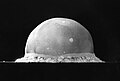 Photo credit: Berlyn BrixnerThe Trinity nuclear test explosion, .016 seconds after detonation. The fireball is about 200 metres (700 ft) wide. Conducted by the United States on July 16, 1945, at a location 35 miles (56 km) southeast of Socorro, New Mexico, on what is now White Sands Missile Range, Trinity was the first test of technology for a nuclear weapon.
 -
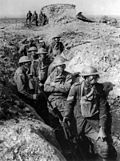 Photo credit: Frank HurleyA group of Australian infantry wearing Small Box Respirators (SBRs) at the Third Battle of Ypres in September 1917. After the introduction of poison gas in World War I, countermeasures were developed. SBRs represented the pinnacle of gas mask development during the war, a mouthpiece connected via a hose to a box filter (hanging around the wearer's neck in this picture), which in turn contained granules of chemicals that neutralised the gas. The SBR was the prized possession of the ordinary infantryman; when the British were forced to retreat during the German Spring Offensive of 1918, it was found that while some troops had discarded their rifles, hardly any had left behind their respirators.
 -
![Image 5 Apollo 11 Photograph credit: Neil Armstrong Apollo 11 was the fifth crewed mission of NASA's Apollo program. After launching from the Kennedy Space Center in Florida on July 16, 1969, commander Neil Armstrong and Apollo Lunar Module pilot Buzz Aldrin landed Eagle in Mare Tranquillitatis on July 20, at 20:17:40 UTC, while command module pilot Michael Collins remained on Columbia in lunar orbit. Armstrong was the first to exit the spacecraft, stepping onto the surface 6 hours and 39 minutes later, on July 21, at 02:56:15 UTC; nineteen minutes later, Aldrin joined him on extravehicular activity, which lasted 2 hours, 31 minutes and 40 seconds. Armstrong and Aldrin lifted off from Tranquility Base after almost 22 hours on the lunar surface and rejoined Collins in the command module, before splashing down in the Pacific Ocean on July 24. The mission was planned to the minute, with the majority of the photographic tasks performed by Armstrong with a single Hasselblad camera. Most of the photographs taken on the Moon that include an astronaut are of Aldrin; there are only five images of Armstrong partly shown or reflected, as in this photograph, with Armstrong and the lunar module reflected in Aldrin's helmet visor. "As the sequence of lunar operations evolved," Aldrin explained, "Neil had the camera most of the time [...] It wasn't until we were back on Earth and in the Lunar Receiving Laboratory looking over the pictures that we realized there were few pictures of Neil." More featured pictures](http://upload.wikimedia.org/wikipedia/commons/thumb/9/98/Aldrin_Apollo_11_original.jpg/120px-Aldrin_Apollo_11_original.jpg) Photograph credit: Neil ArmstrongApollo 11 was the fifth crewed mission of NASA's Apollo program. After launching from the Kennedy Space Center in Florida on July 16, 1969, commander Neil Armstrong and Apollo Lunar Module pilot Buzz Aldrin landed Eagle in Mare Tranquillitatis on July 20, at 20:17:40 UTC, while command module pilot Michael Collins remained on Columbia in lunar orbit. Armstrong was the first to exit the spacecraft, stepping onto the surface 6 hours and 39 minutes later, on July 21, at 02:56:15 UTC; nineteen minutes later, Aldrin joined him on extravehicular activity, which lasted 2 hours, 31 minutes and 40 seconds. Armstrong and Aldrin lifted off from Tranquility Base after almost 22 hours on the lunar surface and rejoined Collins in the command module, before splashing down in the Pacific Ocean on July 24.
Photograph credit: Neil ArmstrongApollo 11 was the fifth crewed mission of NASA's Apollo program. After launching from the Kennedy Space Center in Florida on July 16, 1969, commander Neil Armstrong and Apollo Lunar Module pilot Buzz Aldrin landed Eagle in Mare Tranquillitatis on July 20, at 20:17:40 UTC, while command module pilot Michael Collins remained on Columbia in lunar orbit. Armstrong was the first to exit the spacecraft, stepping onto the surface 6 hours and 39 minutes later, on July 21, at 02:56:15 UTC; nineteen minutes later, Aldrin joined him on extravehicular activity, which lasted 2 hours, 31 minutes and 40 seconds. Armstrong and Aldrin lifted off from Tranquility Base after almost 22 hours on the lunar surface and rejoined Collins in the command module, before splashing down in the Pacific Ocean on July 24.
The mission was planned to the minute, with the majority of the photographic tasks performed by Armstrong with a single Hasselblad camera. Most of the photographs taken on the Moon that include an astronaut are of Aldrin; there are only five images of Armstrong partly shown or reflected, as in this photograph, with Armstrong and the lunar module reflected in Aldrin's helmet visor. "As the sequence of lunar operations evolved," Aldrin explained, "Neil had the camera most of the time [...] It wasn't until we were back on Earth and in the Lunar Receiving Laboratory looking over the pictures that we realized there were few pictures of Neil." -
%2C_by_John_Trumbull.jpg/120px-Declaration_of_Independence_(1819)%2C_by_John_Trumbull.jpg) Painting credit: John TrumbullJohn Trumbull's Declaration of Independence, a 12 by 18 feet (3.7 by 5.5 m) oil painting depicting the presentation of a draft of the United States Declaration of Independence to the Second Continental Congress. While this event did take place, it was not actually in the presence of all the people in the picture. The painting can be found in the rotunda of the United States Capitol.
Painting credit: John TrumbullJohn Trumbull's Declaration of Independence, a 12 by 18 feet (3.7 by 5.5 m) oil painting depicting the presentation of a draft of the United States Declaration of Independence to the Second Continental Congress. While this event did take place, it was not actually in the presence of all the people in the picture. The painting can be found in the rotunda of the United States Capitol. -
 The "Theatre" at PetraPhoto: Douglas PerkinsPetra is an archaeological site in Jordan, lying in a basin among the mountains which form the eastern flank of Wadi Araba, the great valley running from the Dead Sea to the Gulf of Aqaba. It is famous for having many stone structures carved into the rock.
 -
 Photo: Martin St-AmantMachu Picchu, with the peak Huayna Picchu behind it. Perhaps the most famous Inca site, Machu Picchu is situated on a mountain ridge above the Urubamba Valley in Peru. It was probably built as an estate for the Inca emperor Pachacuti in the 15th century, but abandoned soon after during the Spanish conquest of the Inca Empire. Although known locally, it was unknown to the outside world before being brought to international attention in 1911 by the American historian Hiram Bingham, and it is now an important tourist attraction.
 -
.jpg/120px-Vegetable_lamb_(Lee%2C_1887).jpg) Artist: Unknown, after Johann ZahnA drawing of the Vegetable Lamb of Tartary (Agnus scythicus), a zoophyte of Central Asia. Botanist Henry Lee described it as both a true animal and a living plant, although he did allow for the possibility that the lamb was the fruit of the plant. The lamb was believed to have blood, bones, and flesh like that of a normal lamb. It was connected to the earth by a stem similar to an umbilical cord that propped the lamb up above ground. The cord could flex downward allowing the lamb to feed on the grass and plants surrounding it. Once the plants within reach were eaten, the lamb died, at which point its cotton-like wool would be harvested and used to make textiles.
Artist: Unknown, after Johann ZahnA drawing of the Vegetable Lamb of Tartary (Agnus scythicus), a zoophyte of Central Asia. Botanist Henry Lee described it as both a true animal and a living plant, although he did allow for the possibility that the lamb was the fruit of the plant. The lamb was believed to have blood, bones, and flesh like that of a normal lamb. It was connected to the earth by a stem similar to an umbilical cord that propped the lamb up above ground. The cord could flex downward allowing the lamb to feed on the grass and plants surrounding it. Once the plants within reach were eaten, the lamb died, at which point its cotton-like wool would be harvested and used to make textiles. -
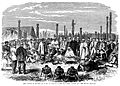 Illustration credit: M. Jackson, Illustrated London NewsThe traditional clothing of the Māori can be seen in this engraving of a meeting between Māori and settlers in Hawke's Bay Province during the Invasion of Waikato in 1863. Muka, the fibre of New Zealand flax, was the basis of most clothing.
 -
 Photo: Martin St-AmantMachu Picchu, a 15th-century Peruvian Inca site located 2,430 metres (7,970 ft) above sea level, as viewed from Huayna Picchu. Established c. 1450, the settlement was abandoned at the time of the Spanish Conquest the following century. Although it remained known locally, it was not brought to international attention until after Hiram Bingham visited the site in 1911. Machu Picchu is now a popular tourist destination and UNESCO World Heritage Site, and restoration efforts are ongoing.
 -
 Photo credit: USHMMJews captured by SS and SD troops during the suppression of the Warsaw Ghetto Uprising are forced to leave their shelter and march to the Umschlagplatz for deportation. The SD trooper pictured second from the right, is Josef Blösche, who was identified by Polish authorities using this photograph. Blösche was tried for war crimes in Erfurt, East Germany in 1969, sentenced to death and executed in July of that year.
 -
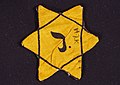 Photograph credit: Ronald TorfsYellow badges are badges that Jews were ordered to wear in public during periods of the Middle Ages by the ruling Christians and Muslims, and in Nazi Germany in the 1940s. The badges served to mark the wearer as a religious or ethnic outsider, and often served as a badge of shame. The badge pictured is in the collection of the Kazerne Dossin Memorial, Museum and Documentation Centre in Mechelen, Belgium.
 -
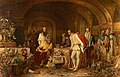 Ivan the Terrible Showing His Treasury to Jerome HorseyArtist: Alexander LitovchenkoAlexander Litovchenko's 1875 painting depicting Ivan IV of Russia seated in the Kremlin Armoury, his half-witted heir Fyodor standing behind, a group of distrustful boyars whispering at a distance, and the Tsar's jester in a skomorokh cap addressing the English diplomat Jerome Horsey. Horsey was a resident of the Russia Company in Moscow from 1572 to 1585.
 -
 Photograph: Andrew ShivaAn aerial view of Masada, an ancient fortification in the Southern District of Israel. Found atop an isolated rock plateau, it overlooks the Dead Sea. The first fortifications on the mountain were built by Alexander Jannaeus, and significantly strengthened by the Roman client king Herod between 37 and 31 BCE. During the First Jewish–Roman War of 66–73 CE, the fortress was besieged, falling only after the 960 Sicarii defending it committed mass suicide.
Masada is among the more popular tourist attractions in Israel, and in 2001 it was made a UNESCO World Heritage Site. -
 1895 train wreck, Gare MontparnassePhoto credit: Studio Lévy and SonsOn October 22, 1895, the Granville–Paris Express train overran the buffer stop at Gare Montparnasse station. The engine careened across almost 30 metres (100 feet) of the station concourse, crashed through a 60 centimetre thick wall, shot across a terrace and sailed out of the station, plummeting onto the Place de Rennes 10 metres (30 feet) below where it stood on its nose. While all of the passengers on board the train survived, one woman on the street below was killed by falling masonry.
 -
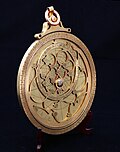 Photograph: Masoud SafarniyaAn Iranian astrolabe, handmade from brass by Jacopo Koushan in 2013. Astrolabes are elaborate inclinometers used by astronomers, navigators, and astrologers from classical antiquity, through the Islamic Golden Age and European Middle Ages, until the Renaissance. These could be used for a variety of purposes, including predicting the positions of the Sun, Moon, planets, and stars; determining local time given local latitude; surveying; triangulation; calculating the qibla; and finding the times for salat.
 -
 A Chola dynasty sculpture depicting Shiva. In Hinduism, Shiva is the deity of destruction and one of the most important gods; in this sculpture he is dancing as Nataraja, the divine dancer who unravels the world in preparation for it being remade by Brahma.


![Image 5 Apollo 11 Photograph credit: Neil Armstrong Apollo 11 was the fifth crewed mission of NASA's Apollo program. After launching from the Kennedy Space Center in Florida on July 16, 1969, commander Neil Armstrong and Apollo Lunar Module pilot Buzz Aldrin landed Eagle in Mare Tranquillitatis on July 20, at 20:17:40 UTC, while command module pilot Michael Collins remained on Columbia in lunar orbit. Armstrong was the first to exit the spacecraft, stepping onto the surface 6 hours and 39 minutes later, on July 21, at 02:56:15 UTC; nineteen minutes later, Aldrin joined him on extravehicular activity, which lasted 2 hours, 31 minutes and 40 seconds. Armstrong and Aldrin lifted off from Tranquility Base after almost 22 hours on the lunar surface and rejoined Collins in the command module, before splashing down in the Pacific Ocean on July 24. The mission was planned to the minute, with the majority of the photographic tasks performed by Armstrong with a single Hasselblad camera. Most of the photographs taken on the Moon that include an astronaut are of Aldrin; there are only five images of Armstrong partly shown or reflected, as in this photograph, with Armstrong and the lunar module reflected in Aldrin's helmet visor. "As the sequence of lunar operations evolved," Aldrin explained, "Neil had the camera most of the time [...] It wasn't until we were back on Earth and in the Lunar Receiving Laboratory looking over the pictures that we realized there were few pictures of Neil." More featured pictures](https://en.wikipedia.org/wiki/File:Aldrin_Apollo_11_original.jpg)
,_by_John_Trumbull.jpg)


.jpg)


Did you know (auto generated)

- ... that the Balconcillo mutiny is considered to be the first coup d'état in the history of Peru?
- ... that "End Zone" Jones ran for a career high in his final regular season game with Nebraska to finish third in the school's history in career rushing yards?
- ... that the compilation of the Wu shu was hampered by the execution of two members of the committee compiling the text?
- ... that the Rani of Jhansi has been described as "the greatest heroine of Indian history"?
- ... that much of the research in dress history has been done from documents, illustrations, and photographs rather than by studying items of clothing?
- ... that officials said this year's Louisiana wildfire season includes the largest wildfire in the state's history?
Featured biography –
.png)
Phạm Ngọc Thảo (IPA: Hanoi: [fâˀm ŋoˀk tʰa᷉ɔ], Saigon: [fə̂ˀm ŋoˀk tʰə᷉ɔ]), also known as Albert Thảo (14 February 1922 – 17 July 1965), was a Vietnamese military officer and spy. He was a sleeper agent of the Việt Minh (and, later, of the People's Army of Vietnam (PAVN)) who infiltrated the Army of the Republic of Vietnam (ARVN) and also became a major provincial leader in South Vietnam. In 1962, he was made overseer of Ngô Đình Nhu's Strategic Hamlet Program in South Vietnam and deliberately forced it forward at an unsustainable speed, causing the production of poorly equipped and poorly defended villages and the growth of rural resentment toward the regime of President Ngô Đình Diệm, Nhu's elder brother. In light of the failed land reform efforts in North Vietnam, the Hanoi government welcomed Thao's efforts to undermine Diem.
During the First Indochina War, Thảo was a communist officer in the Việt Minh and helped oversee various operations in the Mekong Delta in the far south, at one point commanding his future enemy Nguyễn Khánh, who briefly served the communist cause. After the French withdrawal and the partition of Vietnam, Thảo stayed in the south and made a show of renouncing communism. He became part of the military establishment in the anti-communist southern regime and quickly rose through the ranks. Nominally Catholic, Thảo befriended Diệm's elder brother, Archbishop Pierre Martin Ngô Đình Thục; the devoutly Roman Catholic Ngô family strongly favored co-religionists and had great trust in Thảo, unaware that he was still loyal to the communists. He went on to serve as the chief of Bến Tre Province, and gained fame after the area—traditionally a communist stronghold—suddenly became peaceful and prosperous. Vietnamese and US officials, as well as journalists hostile to or supportive of Saigon, misinterpreted this as a testament to Thảo's great ability, and he was promoted to a more powerful position where he could further his sabotage. Thảo and the communists in the local area had simply stopped fighting, so that the communists could quietly recuperate, while Thảo would appear to be very skillful and be given a more important job where he could do more damage. (Full article...)
On this day
February 9: Feast day of Saint Apollonia (in Roman Catholicism and Eastern Orthodoxy)

- 1861 – Jefferson Davis was named the provisional president of the Confederate States of America.
- 1971 – An earthquake registering 6.6 Mw struck the northern San Fernando Valley near the Los Angeles district of Sylmar, killing 65 people.
- 1976 – The Australian Defence Force (ensign pictured) was formed by the integration of the Australian Army, the Royal Australian Navy, and the Royal Australian Air Force.
- 1996 – Breaking a seventeen-month ceasefire, the Provisional Irish Republican Army detonated a powerful truck bomb in the London Docklands, killing two people and injuring more than a hundred others.
- 2001 – The American submarine USS Greeneville collided with the Ehime Maru, a Japanese training vessel operated by a high school, sinking the latter ship and killing nine people on board.
- Agnès Sorel (d. 1450)
- Alberto Vargas (b. 1896)
- Philipp Harnoncourt (b. 1931)
- Tom Hiddleston (b. 1981)
Selected quote
It is of the nature of desire not to be satisfied, and most men live only for the gratification of it.
— Aristotle, 4th-century Greek philosopher
Related portals


More Did you know...

- ... that the Japanese aircraft carrier Amagi (wreck pictured) capsized on 29 July 1945 as a result of cumulative damage inflicted by American airstrikes on 24 and 28 July?
- ... that Scandinavian influence in Scotland, still evident today, was probably at its height during the time of Thorfinn the Mighty?
- ... that, after the 2003 invasion of Iraq, the Bassetki statue, which is more than 4,200 years old, was found in a cesspool?
- ... that in medieval art, angels were often depicted wearing feather tights?
- ... that 49% of German military losses happened in the last 10 months of the Second World War in Europe?
- ... that Joshua L. Goldberg, the first rabbi to serve as a World War II U.S. navy chaplain, was a Russian army deserter?
- ... that Richard Nixon chose the Wilson desk as his Oval Office desk because he believed it was used by Woodrow Wilson, informed that it was used by Henry Wilson, Vice President under Ulysses S. Grant, but actually bought by Garret Augustus Hobart, 24th Vice President of the United States under President William McKinley?
- ... that some of the nominally silver Roman coins from the Bredon Hill Hoard only have a 1% silver content?
Topics
| Primary | |
|---|---|
| Interdisciplinary |
|
| List | |
| Other categorizations | |

| Key concepts | |||||||||
|---|---|---|---|---|---|---|---|---|---|
| Measurement and standards |
| ||||||||
| Philosophy of time | |||||||||
| Human experience and use of time | |||||||||
| Time in science |
| ||||||||
| Related | |||||||||

Categories

History • By period • By region • By topic • By ethnic group • Historiography • Archaeology • Books • Maps • Images • Magazines • Organizations • Fictional • Museums • Pseudohistory • Stubs • Timelines • Chronology • People • Wikipedia historians
WikiProjects
 WikiProject History •
Ancient Near East • Australian History • Classical Greece and Rome • Dacia • Former countries • History of Canada • Chinese history • European history • Heraldry and vexillology • Indian history • Jewish history • Medieval Scotland • Mesoamerica • Military history • Middle Ages • History of Science
WikiProject History •
Ancient Near East • Australian History • Classical Greece and Rome • Dacia • Former countries • History of Canada • Chinese history • European history • Heraldry and vexillology • Indian history • Jewish history • Medieval Scotland • Mesoamerica • Military history • Middle Ages • History of Science
WikiProject Time • Days of the Year • Years
WikiProject Biography • Composers • Political figures • Saints • United States Presidents
Things you can do
 |
Here are some tasks awaiting attention:
|
Associated Wikimedia
The following Wikimedia Foundation sister projects provide more on this subject:
-
 Commons
Free media repository -
 Wikibooks
Free textbooks and manuals -
 Wikidata
Free knowledge base -
 Wikinews
Free-content news -
 Wikiquote
Collection of quotations -
 Wikisource
Free-content library -
 Wikiversity
Free learning tools -
 Wiktionary
Dictionary and thesaurus


