Geography (from Ancient Greekγεωγραφίαgeōgraphía; combining gê 'Earth' and gráphō 'write', literally 'Earth writing') is the study of the lands, features, inhabitants, and phenomena of Earth. Geography is an all-encompassing discipline that seeks an understanding of Earth and its human and natural complexities—not merely where objects are, but also how they have changed and come to be. While geography is specific to Earth, many concepts can be applied more broadly to other celestial bodies in the field of planetary science. Geography has been called "a bridge between natural science and social science disciplines."
The history of geography as a discipline spans cultures and millennia, being independently developed by multiple groups, and cross-pollinated by trade between these groups. Geography as a discipline dates back to the earliest attempts to understand the world spatially, with the earliest example of an attempted world map dating to the 9th century BC in ancient Babylon. Origins of many of the concepts in geography can be traced to Greek Eratosthenes of Cyrene, who may have coined the term "geographia" (c. 276 BC – c. 195/194 BC). The first recorded use of the word γεωγραφία was as the title of a book by Greek scholar Claudius Ptolemy (100 – 170 AD). During the Middle Ages, geography was influenced by Islamic scholars, like Muhammad al-Idrisi, producing detailed maps of the world. The Age of Discovery was influential in the development of geography, as European explorers mapped the New World. Modern developments include the development of geomatics and geographic information science.
The core concepts of geography consistent between all approaches are a focus on space, place, time, and scale. Today, geography is an extremely broad discipline with multiple approaches and modalities. The main branches of geography are physical geography, human geography, and technical geography. Physical geography focuses on the natural environment, human geography focuses on how humans interact with the Earth, and technical geography focuses on the development of tools for understanding geography. Techniques employed can generally be broken down into quantitative and qualitative approaches, with many studies taking mixed-methods approaches. Common techniques include cartography, remote sensing, interviews, and surveying. (Full article...)
Featured articles are displayed here, which represent some of the best content on English Wikipedia.
Image 1
Sunset in the Rincon Mountain District of the park
Saguaro National Park is a national park of the United States in southeastern Arizona. The 92,000-acre (37,000 ha) park consists of two separate areas—the Tucson Mountain District (TMD), about 10 miles (16 km) west of Tucson, and the Rincon Mountain District (RMD), about 10 miles (16 km) east of the city. Both districts preserve Sonoran Desert landscapes, fauna, and flora, including the giant saguaro cactus.
The volcanic rocks on the surface of the Tucson Mountain District differ greatly from the surface rocks of the Rincon Mountain District; over the past 30 million years, crustal stretching displaced rocks from beneath the Tucson Mountains of the Tucson Mountain District to form the Rincon Mountains of the Rincon Mountain District. Uplifted, domed, and eroded, the Rincon Mountains are significantly higher and wetter than the Tucson Mountains. The Rincons, as one of the Madrean Sky Islands between the southern Rocky Mountains and the Sierra Madre Oriental in Mexico, support high biodiversity and are home to many plants and animals that do not live in the Tucson Mountain District. (Full article...)
Chew Stoke has a long history, as shown by the number and range of its heritage-listed buildings. The village is at the northern end of Chew Valley Lake, which was created in the 1950s, close to a dam, pumping station, sailing club, and fishing lodge. A tributary of the River Chew, which rises in Strode, runs through the village. (Full article...)
Image 3
Looking west over the scrape, an area of shallow water and bare mud
The nature reserve is managed primarily for bird conservation, particularly through control and improvement of wetland, heath and grassland habitats, with particular emphasis on encouraging nationally uncommon breeding species such as the bittern, stone-curlew, bearded tit, marsh harrier, nightjar and nightingale. The diversity of habitats has also led to a wide variety of other animals and plants being recorded on the site. (Full article...)
Image 4
Jeannette at Le Havre in 1878, prior to her departure for San Francisco in a trip that would see her round Cape Horn The Jeannetteexpedition of 1879–1881, officially called the U.S. Arctic Expedition, was an attempt led by George W. De Long to reach the North Pole by pioneering a route from the Pacific Ocean through the Bering Strait. The premise was that a temperate current, the Kuro Siwo, flowed northwards into the strait, providing a gateway to the hypothesized Open Polar Sea and thus to the pole.
This theory proved illusory; the expedition's ship, USS Jeannette and its crew of thirty-three men, was trapped by ice and drifted for nearly two years before she was crushed and sunk north of the Siberian coast. De Long then led his men on a perilous journey by sled, dragging the Jeannette'swhaleboat and two cutters, eventually switching to these small boats to sail for the Lena Delta in Siberia. During this journey, and in the subsequent weeks of wandering in Siberia before rescue, twenty of the ship's complement died, including De Long. (Full article...)
Henry McNish (11 September 1874 – 24 September 1930), often referred to as Harry McNish or by the nickname Chippy, was the carpenter on Sir Ernest Shackleton's Imperial Trans-Antarctic Expedition of 1914–1917. He was responsible for much of the work that ensured the crew's survival after their ship, the Endurance, was destroyed when it became trapped in pack ice in the Weddell Sea. He modified the small boat, James Caird, that allowed Shackleton and five men (including McNish) to make a voyage of 800 hundred miles across the perilous Southern Ocean to fetch help for the rest of the crew.
After the expedition he returned to work in the Merchant Navy and eventually emigrated to New Zealand, where he worked on the docks in Wellington until poor health forced his retirement. He died destitute in the Ohiro Benevolent Home in Wellington. (Full article...)
Image 6
Map showing Morrell's reported location of the "New South Greenland" coast (1823, red line), and "Ross's Appearance" as reported by Sir James Clark Ross in 1841. The dotted line indicates the area of Captain Johnson's 1821 voyage.
New South Greenland, sometimes known as Morrell's Land, was an appearance of land recorded by the American captain Benjamin Morrell of the schoonerWasp in March 1823, during a sealing and exploration voyage in the Weddell Sea area of Antarctica. Morrell provided precise coordinates and a description of a coastline which he claimed to have sailed along for more than 300 miles (500 km). Because the Weddell Sea area was so little visited and hard to navigate due to ice conditions, the alleged land was never properly investigated before its existence was emphatically disproven during Antarctic expeditions in the early 20th century.
At the time of Morrell's voyage, the geography of the then-unnamed Weddell Sea and its surrounding coasts was almost entirely unknown, making the claimed sighting initially plausible. However, obvious errors in Morrell's voyage account and his general reputation as a fabulist created scepticism about the existence of this new land. In June 1912, the German explorer Wilhelm Filchner searched for but found no traces of land after his ship Deutschland became icebound in the Weddell Sea and drifted into the locality of Morrell's observation. A line sounding of the sea bottom revealed more than 5,000 feet (1,500 m) of water, indicating no land in near proximity. Three years later, trapped in the same waters with his ship Endurance, Ernest Shackleton was able by similar means to confirm the land's implausibility. (Full article...)
The Kingdom of Mysore was a geopolitical realm in southern India founded in around 1399 in the vicinity of the modern-day city of Mysuru and prevailed until 1950. The territorial boundaries and the form of government transmuted substantially throughout the kingdom's lifetime. While originally a feudal vassal under the Vijayanagara Empire, it became a princely state in British Raj from 1799 to 1947, marked in-between by major political changes.
The kingdom, which was founded and ruled for the most part by the Wadiyars, initially served as a feudal vassal under the Vijayanagara Empire. With the gradual decline of the Empire, the 16th-century Timmaraja Wodeyar II declared independence from it. The 17th century saw a steady expansion of its territory and, during the rules of Narasaraja Wodeyar I and Devaraja Wodeyar II, the kingdom annexed large expanses of what is now southern Karnataka and parts of Tamil Nadu, becoming a formidable power in the Deccan. (Full article...)
Image 9
Enceladus imaged by the Cassini orbiter, October 2015
Enceladus is the sixth-largest moon of Saturn and the 18th largest in the Solar System. It is about 500 kilometres (310 miles) in diameter, about a tenth of that of Saturn's largest moon, Titan. It is covered by clean, freshly deposited snow hundreds of meters thick, making it one of the most reflective bodies of the Solar System. Consequently, its surface temperature at noon reaches only −198 °C (75.1 K; −324.4 °F), far colder than a light-absorbing body would be. Despite its small size, Enceladus has a wide variety of surface features, ranging from old, heavily cratered regions to young, tectonically deformed terrain.
Enceladus was discovered on August 28, 1789, by William Herschel, but little was known about it until the two Voyager spacecraft, Voyager 1 and Voyager 2, flew by Saturn in 1980 and 1981. In 2005, the spacecraft Cassini started multiple close flybys of Enceladus, revealing its surface and environment in greater detail. In particular, Cassini discovered water-rich plumes venting from the south polar region. Cryovolcanoes near the south pole shoot geyser-like jets of water vapour, molecular hydrogen, other volatiles, and solid material, including sodium chloride crystals and ice particles, into space, totalling about 200 kilograms (440 pounds) per second. More than 100 geysers have been identified. Some of the water vapour falls back as snow, now several hundred metres thick; the rest escapes and supplies most of the material making up Saturn's E ring. According to NASA scientists, the plumes are similar in composition to comets. In 2014, NASA reported that Cassini had found evidence for a large south polar subsurface ocean of liquid water with a thickness of around 10 km (6 mi). The existence of Enceladus's subsurface ocean has since been mathematically modelled and replicated. (Full article...)
Covent Garden is a district in London, on the eastern fringes of the West End, between St Martin's Lane and Drury Lane. It is associated with the former fruit-and-vegetable market in the central square, now a popular shopping and tourist site, and with the Royal Opera House, itself known as "Covent Garden". The district is divided by the main thoroughfare of Long Acre, north of which is given over to independent shops centred on Neal's Yard and Seven Dials, while the south contains the central square with its street performers and most of the historical buildings, theatres and entertainment facilities, including the London Transport Museum and the Theatre Royal, Drury Lane.
The area was fields until briefly settled in the 7th century when it became the heart of the Anglo-Saxon trading town of Lundenwic, then abandoned at the end of the 9th century after which it returned to fields. By 1200 part of it had been walled off by the Abbot of Westminster Abbey for use as arable land and orchards, later referred to as "the garden of the Abbey and Convent", and later "the Convent Garden". Following the Dissolution of the Monasteries it was granted in 1552 by the young King Edward VI to John Russell, 1st Earl of Bedford (c.1485–1555), the trusted adviser to his father King Henry VIII. The 4th Earl commissioned Inigo Jones to build some fine houses to attract wealthy tenants. Jones designed the Italianate arcaded square along with the church of St Paul's. The design of the square was new to London and had a significant influence on modern town planning, acting as the prototype for new estates as London grew. (Full article...)
Occupation and partition of Yugoslavia in 1941. The Hungarian-occupied then annexed areas of Yugoslavia are in the north (Bačka and Baranja) and northwest (Međimurje and Prekmurje).
During World War II, the Kingdom of Hungary engaged in the military occupation, then annexation, of the Bačka, Baranja, Međimurje and Prekmurje regions of the Kingdom of Yugoslavia. These territories had all been under Hungarian rule prior to 1920, and had been transferred to Yugoslavia as part of the post-World War ITreaty of Trianon. They now form part of several states: Yugoslav Bačka is now part of Vojvodina, an autonomous province of Serbia, Yugoslav Baranja and Međimurje are part of modern-day Croatia, and Yugoslav Prekmurje is part of modern-day Slovenia. The occupation began on 11 April 1941 when 80,000 Hungarian troops crossed the Yugoslav border in support of the German-led Axisinvasion of Yugoslavia that had commenced five days earlier. There was some resistance to the Hungarian forces from SerbChetnik irregulars, but the defences of the Royal Yugoslav Army had collapsed by this time. The Hungarian forces were indirectly aided by the local Volksdeutsche, the German minority, which had formed a militia and disarmed around 90,000 Yugoslav troops. Despite only sporadic resistance, Hungarian troops killed many civilians during these initial operations, including some Volksdeutsche. The government of the newly formed Axis puppet state, the Independent State of Croatia, subsequently consented to the Hungarian annexation of the Međimurje area, which dismayed the Croat population of the region.
The occupation authorities immediately classified the population of Bačka and Baranja into those that had lived in those regions when they had last been under Hungarian rule in 1920 and the mostly Serb settlers who had arrived since the areas had been part of Yugoslavia. They then began herding thousands of local Serbs into concentration camps and expelled them to the Independent State of Croatia, Italian-occupied Montenegro, and the German-occupied territory of Serbia. Ultimately, tens of thousands of Serbs were deported from the occupied territories. This was followed by the implementation of a policy of "magyarisation" of the political, social and economic life of the occupied territories, which included the re-settlement of Hungarians and Székelys from other parts of Hungary. "Magyarisation" did not impact the Volksdeutsche, who received special status under Hungarian rule, and in Prekmurje the Hungarian authorities were more permissive towards ethnic Slovenes. (Full article...)
Image 14
Antarctica (/ænˈtɑːrktɪkə/ⓘ) is Earth's southernmost and least-populated continent. Situated almost entirely south of the Antarctic Circle and surrounded by the Southern Ocean (also known as the Antarctic Ocean), it contains the geographic South Pole. Antarctica is the fifth-largest continent, being about 40% larger than Europe, and has an area of 14,200,000 km2 (5,500,000 sq mi). Most of Antarctica is covered by the Antarctic ice sheet, with an average thickness of 1.9 km (1.2 mi).
No damage or casualties resulted from the Nazko earthquakes, which were too small to be felt by people, but local seismographs recorded them. The earthquake swarm occurred at the eastern end of a known volcanic zone called the Anahim Volcanic Belt. This is an east–west trending line of volcanic formations extending from the Central Coast to the Central Interior of British Columbia. (Full article...)
The Aitoff projection is a modified azimuthal map projection first proposed by David A. Aitoff in 1889. Based on the equatorial form of the azimuthal equidistant projection, Aitoff halved longitudes from the central meridian, projected by the azimuthal equidistant, and then stretched the result horizontally into a 2:1 ellipse.
The Mollweide projection is an equal-area, pseudocylindrical map projection generally used for global maps of the world or night sky. The projection was first published by mathematician and astronomer Karl Mollweide of Leipzig in 1805 but reinvented and popularized in 1857 by Jacques Babinet. The projection trades accuracy of angle and shape for accuracy of proportions in area, and as such is used where that property is needed, such as maps depicting global distributions.
A satellite image of the Scandinavian Peninsula in winter. The peninsula, approximately 1,850 kilometers (1,150 miles) long with a width varying between approximately 370–805 km (230–500 mi), making it the largest in Europe, is located in the northern part of the continent and consists of Norway, Sweden and part of Finland. Much of the population is concentrated in the southern part of the peninsula; Stockholm and Gothenburg, both in Sweden, and Oslo in Norway are the largest cities.
The sinusoidal projection is a pseudocylindrical equal-areamap projection. Used as early as the 16th century, this projection shows distances accurately along the central meridian and the equator; areas furthest from these lines are the most distorted.
Map: Strebe, using the Geocart map projection software
A two-point equidistant projection of Eurasia. All distances of other points from the two points marked in red (45°N 40°E and 30°N 110°E) are correct. This map is a derivative of NASA's Blue Marble summer month composite, with oceans lightened to enhance legibility and contrast.
The equirectangular projection is a simple map projection attributed to Marinus of Tyre, who Ptolemy claims invented the projection about AD 100. The projection maps meridians to vertical straight lines of constant spacing, and circles of latitude to horizontal straight lines of constant spacing. The projection is neither equal area nor conformal. Because of the distortions introduced by this projection, it has few applications beyond base imagery to be reprojected to some more useful projection.
An 18th century map of the Iberian Peninsula illustrating various topographic features of the land. The Iberian Peninsula, or Iberia, is located in the extreme southwest of Europe, and includes modern day Spain, Portugal, Gibraltar and Andorra.
The Robinson projection is a projection of a world map showing the entire Earth at once. It was specifically created in an attempt to find a good compromise to the problem of showing the whole globe as a single flat image. The projection was devised by Arthur H. Robinson in 1963; distortion is severe close to the poles, but quickly declines to moderate levels as latitudes decrease. This Robinson-projection map, with standard parallels of 38°N and 38°S, was produced by the United States Central Intelligence Agency and shows the world as of February 2016.
The Kavrayskiy VII projection is a map projection invented by Vladimir V. Kavrayskiy in 1939 as a general purpose pseudocylindrical projection. It produces maps with low overall distortion, despite its straight, evenly-spaced parallels and a simple formulation.
The frontispiece of the 1920 edition of Tod's Annals and Antiquities of Rajast'han
Lieutenant-ColonelJames Tod (20 March 1782 – 18 November 1835) was a British army officer and scholar. He combined his official role and his amateur interests to create a series of works about the history and geography of India, and in particular the area then known as Rajputana that corresponds to the present day state of Rajasthan, and which Tod referred to as Rajast'han.
Tod was born in London and educated in Scotland. He joined the East India Company as a military officer and travelled to India in 1799 as a cadet in the Bengal Army. He rose quickly in rank, eventually becoming captain of an escort for an envoy in a Sindian royal court. After the Third Anglo-Maratha War, during which Tod was involved in the intelligence department, he was appointed Political Agent for some areas of Rajputana. His task was to help unify the region under the control of the East India Company. During this period Tod conducted most of the research that he would later publish. Tod was initially successful in his official role, but his methods were questioned by other members of the East India Company. Over time, his work was restricted and his areas of oversight were significantly curtailed. In 1823, owing to declining health and reputation, Tod resigned his post as Political Agent and returned to England. (Full article...)
Venezuela, officially the Bolivarian Republic of Venezuela, is a country on the northern coast of South America, consisting of a continental landmass and various islands and islets in the Caribbean Sea. It comprises an area of 912,050 km2 (352,140 sq mi), with a population estimated at 31.8 million in 2025.[verification needed] The capital and largest urban agglomeration is Caracas. The continental territory is bordered on the north by the Caribbean Sea and the Atlantic Ocean, on the west by Colombia, Brazil on the south, Trinidad and Tobago to the north-east, and on the east by Guyana. Venezuela consists of 23 states, the Capital District, and federal dependencies covering Venezuela's offshore islands. Venezuela is among the most urbanized countries in Latin America; the vast majority of Venezuelans live in the cities of the north and in the capital. (Full article...)
Image 2
Dymaxion map of the world with the 30 largest countries and territories by area
This is a list of the world's countries and their dependencies, ranked by total area, including land and water. (Full article...)
Generation Z, often shortened to Gen Z and informally known as Zoomers, is the demographic cohort succeeding Millennials and preceding Generation Alpha. Researchers and popular media use the mid-to-late 1990s as starting birth years and the early 2010s as ending birth years, with the generation typically being defined as people born from 1997 to 2012. Most members of Generation Z are the children of Generation X, and it is predicted that many will be the parents of the proposed Generation Beta. (Full article...)


 Featured article -


.svg/250px-Antarctica_(orthographic_projection).svg.png)


.svg)

 Vital article
.svg)


 Map credit: Lencer and NordNordWestA general map, showing the geography of Germany, the seventh largest country in Europe and the second most populous. Located in Central Europe, Germany is second only to Russia in the number of borders it shares with other European countries (9).
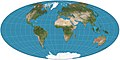 Map: Strebe, using GeocartThe Aitoff projection is a modified azimuthal map projection first proposed by David A. Aitoff in 1889. Based on the equatorial form of the azimuthal equidistant projection, Aitoff halved longitudes from the central meridian, projected by the azimuthal equidistant, and then stretched the result horizontally into a 2:1 ellipse.
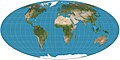 Map: Strebe, using GeocartThe Mollweide projection is an equal-area, pseudocylindrical map projection generally used for global maps of the world or night sky. The projection was first published by mathematician and astronomer Karl Mollweide of Leipzig in 1805 but reinvented and popularized in 1857 by Jacques Babinet. The projection trades accuracy of angle and shape for accuracy of proportions in area, and as such is used where that property is needed, such as maps depicting global distributions.
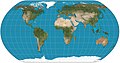 Map: Strebe, using the Geocart map projection softwareA map of the world using the Natural Earth projection, a pseudocylindrical projection which is neither conformal nor equal-area. The projection was designed by Tom Patterson, an American cartographer with the National Park Service who has developed several open-source tools and base maps for cartographers.
 A map showing the geography of Florida, a state in the United States. Situated on a peninsula between the Gulf of Mexico, the Atlantic Ocean, and the Straits of Florida, Florida has an extensive coastline. Its highest point, Britton Hill, is the lowest highpoint of any U.S. state. Florida is home to over 19 million people, living in 410 municipalities.
 A satellite image of the Scandinavian Peninsula in winter. The peninsula, approximately 1,850 kilometers (1,150 miles) long with a width varying between approximately 370–805 km (230–500 mi), making it the largest in Europe, is located in the northern part of the continent and consists of Norway, Sweden and part of Finland. Much of the population is concentrated in the southern part of the peninsula; Stockholm and Gothenburg, both in Sweden, and Oslo in Norway are the largest cities.
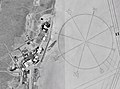 Photo credit: NASAThe world's largest compass rose, drawn on the desert floor at Edwards Air Force Base in California, United States. Painted on the dry lake near Dryden Flight Research Center, it is inclined to magnetic north and is used by pilots for calibrating heading indicators.
 Map: Strebe, using GeocartThe sinusoidal projection is a pseudocylindrical equal-area map projection. Used as early as the 16th century, this projection shows distances accurately along the central meridian and the equator; areas furthest from these lines are the most distorted.
 Map: Strebe, using the Geocart map projection softwareA two-point equidistant projection of Eurasia. All distances of other points from the two points marked in red (45°N 40°E and 30°N 110°E) are correct. This map is a derivative of NASA's Blue Marble summer month composite, with oceans lightened to enhance legibility and contrast.
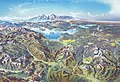 Map credit: Heinrich C. BerannYellowstone National Park is an American national park located mostly in Wyoming and extending into Montana and Idaho. It was established by the U.S. Congress and signed into law by President Ulysses S. Grant on March 1, 1872. Yellowstone was the first national park in the U.S. and is also widely held to be the first national park in the world. The park is known for its wildlife and its many geothermal features, especially the Old Faithful geyser, one of its most popular landmarks. It has many types of ecosystems, but the subalpine forest is the most abundant. The park is part of the South Central Rockies forests ecoregion. In 1978, Yellowstone was named a World Heritage Site by UNESCO.
 Map: Strebe, using GeocartThe equirectangular projection is a simple map projection attributed to Marinus of Tyre, who Ptolemy claims invented the projection about AD 100. The projection maps meridians to vertical straight lines of constant spacing, and circles of latitude to horizontal straight lines of constant spacing. The projection is neither equal area nor conformal. Because of the distortions introduced by this projection, it has few applications beyond base imagery to be reprojected to some more useful projection.
 Map credit: Robert WilkinsonAn 18th century map of the Iberian Peninsula illustrating various topographic features of the land. The Iberian Peninsula, or Iberia, is located in the extreme southwest of Europe, and includes modern day Spain, Portugal, Gibraltar and Andorra.
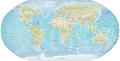 Map credit: Central Intelligence AgencyThe Robinson projection is a projection of a world map showing the entire Earth at once. It was specifically created in an attempt to find a good compromise to the problem of showing the whole globe as a single flat image. The projection was devised by Arthur H. Robinson in 1963; distortion is severe close to the poles, but quickly declines to moderate levels as latitudes decrease. This Robinson-projection map, with standard parallels of 38°N and 38°S, was produced by the United States Central Intelligence Agency and shows the world as of February 2016.
 Map: Strebe, using GeocartThe Hammer retroazimuthal projection is a modified azimuthal proposed by Ernst Hermann Heinrich Hammer in 1910. As a retroazimuthal projection, azimuths (directions) are correct from any point to the designated center point. In whole-world presentation, the back and front hemispheres overlap, making the projection a surjective function. Here, the frontside and backside hemispheres, both with a 15° graticule and center point of 45°N, 90°W, are presented side-by-side.
 Map: Strebe, using GeocartThe Kavrayskiy VII projection is a map projection invented by Vladimir V. Kavrayskiy in 1939 as a general purpose pseudocylindrical projection. It produces maps with low overall distortion, despite its straight, evenly-spaced parallels and a simple formulation.





.svg/40px-Earth_symbol_(bold).svg.png)
.svg/20px-Globus_cruciger_(bold).svg.png)


.svg)
.svg)

.jpeg)


 Categories
 Commons
 Wikibooks
 Wikidata
 Wikinews
 Wikiquote
 Wikisource
 Wikiversity
 Wikivoyage
 Wiktionary


